When Should a Business Build Custom Software?
Seven clear signs you need custom software, the signs you do not, and a five-question test to decide when to build custom software for your business.
By BAMS Technology Team 4 min read
In this article
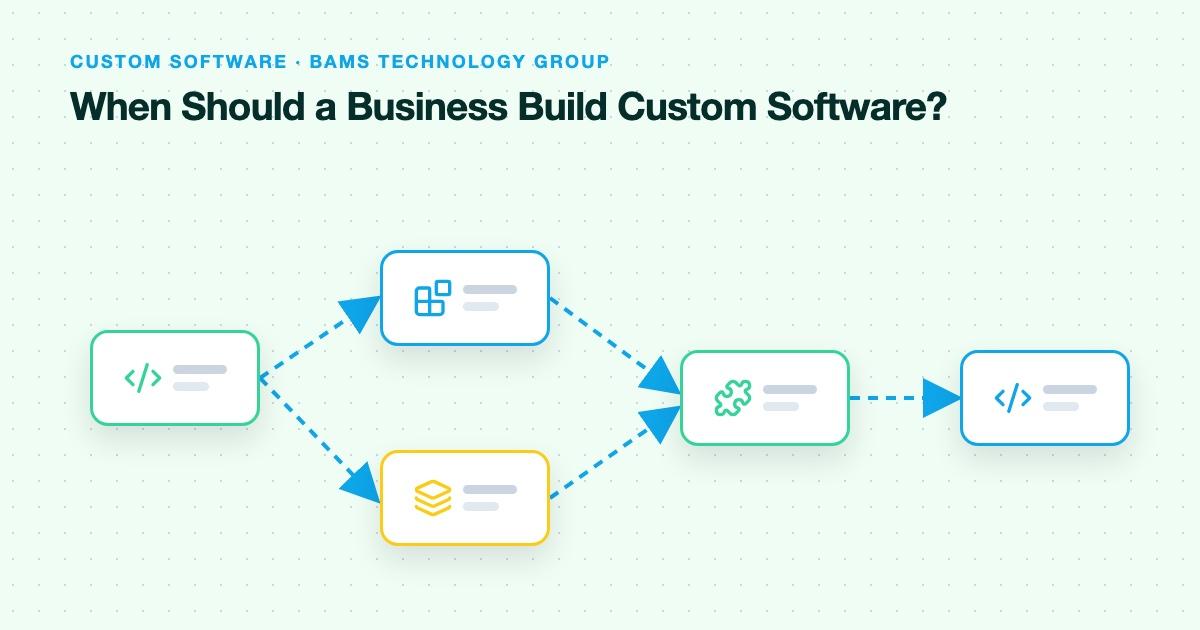
Knowing when to build custom software is one of the harder calls a business owner makes. Build too early and you spend heavily on something a subscription could have handled. Wait too long and your team keeps losing hours to workarounds that quietly slow growth.
This article walks through the clearest signs you need custom software, the signs you do not, and a practical test you can run before committing. For background on what custom work involves, see our custom business software guide.
Seven signs you need custom software
1. Your team keeps re-entering the same data
If a customer's details are typed into your CRM, your scheduling tool and your invoicing system, errors creep in. When integrations between those tools are not possible or keep breaking, a custom layer can make the data move once.
2. A spreadsheet has become a critical system
Spreadsheets are great for starting out. They become risky when only one person understands the formulas, several people edit the same file, or a mistake affects billing or customers.
3. Your process is a competitive advantage
If the way you quote, deliver or serve customers is what sets you apart, forcing it into a generic tool can erase that edge. Custom software can protect and scale it.
4. You have outgrown every option you tried
You have tested several products, and each one handles part of the job but misses the part that matters most. That pattern suggests your need is genuinely specific.
5. Customers or partners need a tailored portal
When clients, vendors or field teams need secure access to their own information in a way no product offers, a custom portal is often the cleanest answer.
6. Reporting takes too long to trust
If building a weekly report means exporting from several systems and stitching them together, decisions slow down and errors multiply.
7. You plan to sell the software
Some businesses realize their internal tool could serve others in their industry. That is a product decision, and it usually requires building rather than configuring.
Signs you probably do not need to build
- Your process is standard for your industry and a product fits it with minor changes.
- The gap is small, such as a missing field or report that a configurable product can handle.
- You have not tried the obvious options yet. Test before you build.
- No one inside the business can own the project. Custom software needs a decision-maker.
- The process is still changing every month. Settle it first, then automate or build.
Often the better answer is a product you can configure or extend. Our article on when to configure instead of build covers that middle path.
A five-question test before you build
- What exactly is broken? Name the process and the cost: time lost, errors, missed revenue, poor customer experience.
- Have we tried configuring an existing product? List what was tried and where it fell short.
- Can we start from a product and extend it? Building only the missing part is usually faster and lower-risk.
- Who will own it? Identify the person who makes decisions during the project and after launch.
- What does a small first version look like? If you cannot describe one, the scope is not clear enough yet.
If you can answer all five with confidence, you are ready for a scoping conversation.
Custom vs off-the-shelf in one view
| If this is true… | Lean toward |
|---|---|
| Your process matches most of your industry | Off-the-shelf, configured |
| A product covers most needs, with a few unique steps | Customize an existing product |
| The core of your process is unique and valuable | Build custom |
| You want to sell the software to others | Build custom |
| You need results quickly with a small budget | Off-the-shelf first |
Our resource on custom SaaS vs off-the-shelf software compares these options in more depth.
What to prepare before talking to a developer
- A short description of the process and who is involved
- Examples of the spreadsheets, forms or reports you use today
- The tools the new software must connect with
- What "working" looks like for the first release
- Any data-handling rules that apply to your industry
Remember: The goal is not custom software. The goal is removing the cost of a process that does not work. Sometimes that takes code; sometimes it takes a better-configured product.
Frequently asked questions
Is it too early to build custom software for a small business?
It depends on the problem, not the size of the business. If a specific process costs real time or revenue and no product handles it, a focused custom tool can make sense even for a small team.
Can we build custom software in stages?
Yes, and it is usually the safer approach. A small first release solves the most expensive problem, and later releases build on what you learn.
What is the biggest risk of building custom software?
Unclear scope. Projects without a defined first version and an internal decision-maker tend to grow without delivering value. A clear problem statement reduces that risk.